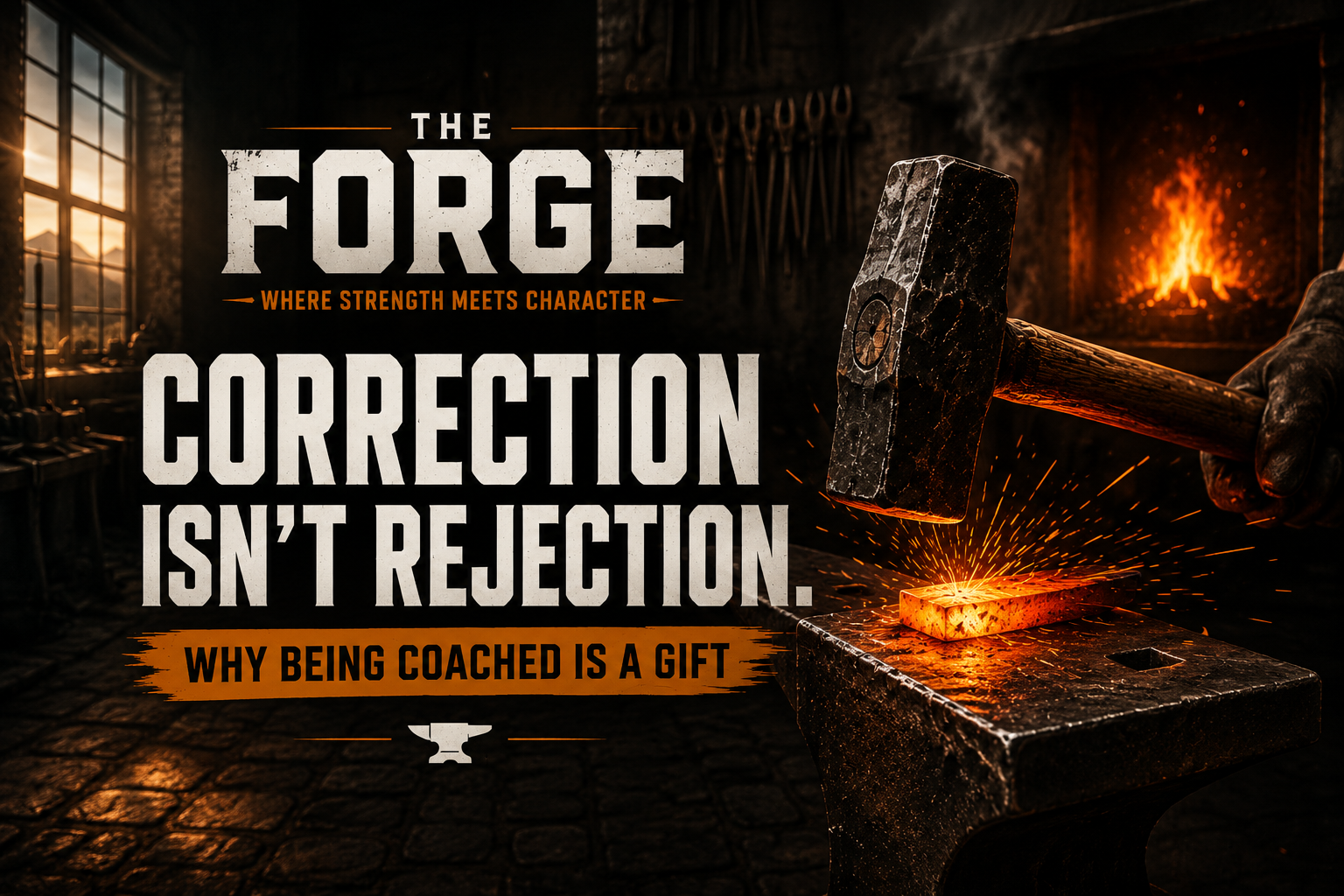
Correction Isn’t Rejection: Why Being Coached Is a Gift
There is a sentence I wish more young people understood:
Correction is not rejection. Correction is an investment.
Somewhere along the way, many of us began confusing being corrected with being criticized.
A teacher marks something wrong.
A coach stops a drill.
A parent says, “We need to talk about what happened.”
Immediately, the defenses go up.
They’re mad at me.
They don’t think I’m good enough.
They don’t like me.
But what if we taught young people to see correction differently?
What if correction isn’t evidence that someone has given up on you?
What if it’s evidence that they haven’t?
The Hammer Isn’t Angry at the Steel
Think about a blacksmith working a piece of steel.
Heat.
Hammer.
Heat again.
Another strike.
The hammer isn’t angry at the steel.
The blacksmith isn’t punishing it.
He sees what the steel can become.
Every strike has a purpose.
That’s one of the great misunderstandings about coaching, teaching, parenting, mentoring, and leadership.
Healthy correction isn’t:
“Something is wrong with you.”
It’s:
“Something about what you’re doing needs to change.”
Those are very different messages.
One attacks identity.
The other develops ability.
Condemnation, Correction, and Coaching
Young people need help distinguishing between three things that can initially feel very similar.
Condemnation says:
Something is wrong with you.
Correction says:
Something you’re doing needs to change.
Coaching says:
I believe you can change it, and I’m willing to help.
Good teachers live mostly in that third category.
So do good coaches.
And good parents.
That doesn’t mean every correction will be delivered perfectly. Adults are human too. Coaches get frustrated. Parents get tired. Teachers occasionally choose the wrong words.
But imperfect delivery doesn’t automatically make useful feedback useless.
Learning to separate the message from the emotion surrounding the message is part of growing up.
Watch Great Athletes Receive Coaching
I’ve spent decades around athletes, and one characteristic appears again and again in the ones who improve fastest:
They become coachable.
Watch inexperienced athletes receive correction.
Their shoulders drop.
They explain what happened.
They point toward someone else.
“I know.”
“But I thought…”
“That’s what I was trying to do.”
Now watch experienced competitors.
Coach gives feedback.
They listen.
They nod.
They try again.
Sometimes the entire conversation lasts five seconds.
That’s not weakness.
That’s maturity.
The best athletes eventually learn something enormously valuable:
Feedback is data. It doesn’t have to become drama.
The Goal Isn’t to Never Be Corrected
Imagine walking into basketball practice and your coach never corrects you.
Every shot is fine.
Every defensive rotation is fine.
Every effort level is fine.
At first, that might feel wonderful.
Eventually, you should become worried.
Because nobody improves that way.
The goal of practice isn’t to create an environment where you never make mistakes.
Practice is where mistakes become information.
School should work similarly.
So should leadership.
So should life.
Instead of asking:
“How do I avoid being corrected?”
Ask a stronger question:
How quickly can I turn correction into improvement?
That changes everything.
Your Response to Correction Reveals Your Character
Correction creates a tiny crossroads.
You can defend.
You can blame.
You can shut down.
You can make excuses.
Or you can become curious.
“What did you see?”
“What should I have done differently?”
“Can I try it again?”
Those may be three of the most powerful sentences a young person can learn.
Not because adults are always right.
They’re not.
Not because you should blindly obey every opinion someone gives you.
You shouldn’t.
Wisdom includes learning which voices deserve influence in your life.
But when a trustworthy teacher, parent, coach, or mentor takes the time to help you improve, don’t automatically interpret that moment as rejection.
Consider another possibility.
They may be investing in you.
Parents and Coaches: How We Correct Matters
There is another side to this conversation.
If we want young people to receive correction well, adults must learn to give correction well.
Correction should preserve dignity.
Whenever possible, correct the behavior without attacking the person.
Instead of:
“You’re lazy.”
Try:
“That effort isn’t your standard.”
Instead of:
“You’re disrespectful.”
Try:
“The way you handled that was disrespectful. Let’s fix it.”
Instead of:
“You’re terrible at this.”
Try:
“You’re not there yet. Here’s what we need to work on.”
Words matter because identity matters.
We aren’t trying to produce children who believe they are failures.
We’re trying to develop young people who can recognize failure, learn from it, and move forward.
That is an entirely different thing.
Correction Is a Form of Hope
Think about the people you no longer bother correcting.
Usually, they’re people you’ve stopped expecting anything from.
That’s sobering.
Correction often exists precisely because expectation still exists.
A teacher sees more.
A coach sees more.
A parent sees more.
A mentor sees more.
Sometimes they can see the next version of you before you can.
Healthy correction says:
This isn’t your ceiling.
You can learn.
You can adjust.
You can become wiser.
You can become stronger.
You can try again.
Welcome to the Forge
Steel doesn’t become useful because it avoided the hammer.
Athletes don’t become excellent because coaches stopped correcting them.
Students don’t become leaders because adults protected them from every uncomfortable conversation.
Growth requires feedback.
Character requires humility.
Leadership requires enough security to hear:
“That wasn’t good enough.”
…and respond:
“Okay. Show me how to make it better.”
That is a powerful young person.
And eventually, that becomes a powerful adult.
So the next time someone you trust corrects you, resist the instinct to immediately defend yourself.
Listen.
Consider it.
Take what is true.
Make the adjustment.
Then step back into the Forge.
Because correction isn’t rejection.
Sometimes correction is one of the clearest signs that someone still believes in who you can become.
The Forge
Where Strength Meets Character
Athletes are trained. Leaders are forged.